The Celebration of Holy Communion
The celebration of Holy Communion has been at the core of Christian worship from its foundation, but the style and practice has altered over the centuries and still differs a little between the different forms of Christianity. Even within the Church of Scotland the procedure for celebration of the Sacrament has changed over the centuries. Turning again to the 17th Century Dundonald Session Minutes we find, around 1640, a full set of instructions for dispensing of Communion at that time. Here is an extract to give a flavour (the language has been up-dated ):
Directions for those who serve at the tables.
Let……..attend the basin ……attend the cups at the south table ……….at the north table.
Let the larger of the two basins serve the mid table and after serving the two side tables let those who served the south table serve the south side of the middle table also, and they who served with the cup at the north table let them, when it is served, serve the north side of the middle table also, and let a deacon carry down the other empty cup to the table.
Let those who serve at the table have this also for their charge to see that the forms be not altered neither to nor further from the table, or, if any alteration be, that they be set right again, and likewise the board cloths.
They must have care that the tables be conveniently packed and that the people coming from the tables go not through the body of the Church but be conveyed out at the choir door.
This describes a procedure very different from that used today, but things were very different in the 17th and 18th century. When Communion was held, virtually the whole parish would turn out and some would attend from other adjoining parishes. Such numbers could not be accommodated within the Church at one sitting, so the crowds gathered in the Churchyard and were admitted to the church in groups who would then be served at tables set up in the centre of the Church. The procedure would last all day and simple food and refreshment would be provided for the congregation. There was a break in the middle of the day when the elders and some of the more important members of the congregation would join the Minister for lunch in the Manse.
This procedure was common throughout the lowland parishes and continued in this general form until well into the 19th century. Sometimes a Fair would be held along with the celebration and people would be preached to by a variety of ministers and elders as they waited in the area around the Church. With large numbers of people spending most of the day in and around the Church it is perhaps not surprising that behaviour could degenerate on these occasions and during the 18th century the practice of Holy Fairs gained a somewhat questionable reputation. Read Robert Burns’ poem ‘The Holy Fair’ to get the flavour!
Some interesting points can be taken from the Communion instructions reproduced above. Firstly, the date at which they appear in the minutes is significant. The period around 1640 was right at the start of the dispute over forms of worship and the Church is making a clear statement about how Communion will be celebrated. The instruction concerning the position of the benches in relation to the table is important in this respect. Benches had to be close enough to the table to prevent the communicant from kneeling, a practice disapproved of by the Presbyterian church.
While today members are invited to Communion by receiving a simple card, in the times described here admission to Communion was allowed only on production of a token such as the examples shown in the photographs:
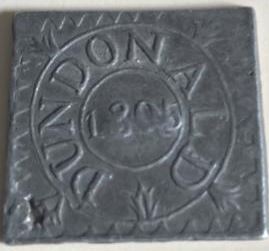
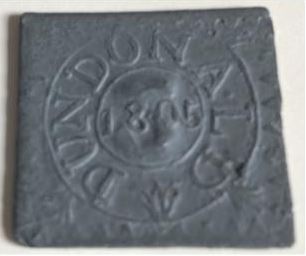
Above - Dundonald Communion Tokens from 1805
Tokens were distributed to members by the elders, but they were only given out to those who could prove their worth by responding correctly to questions from the catechism. The door to the Church would be manned by an elder who would collect the tokens. The instructions also state that only the door free from wind would be used. Clearly the weather was as bad then as it is now! Some communion tokens also have a number on them, it was not uncommon for the minister to have to take 7 communion services in one day! Other local ministers would help share the load but the number on the token was the sitting number you had to attend.
Some of the Communion pewter used at these old communions is shown in the photograph. Some items are possibly more than 300 years old. Two plates dated 1816 have ‘Success to the United States’ inscribed around a full-rigged ship. The two jugs are marked ‘Mayy (sic) the United States Flourish’. These items are said to have been given to the Church by the Galt brothers, one of whom, John Galt, is a well-known Scottish novelist. The references to the United States are not unique to Dundonald and may represent a sort of tradesman’s stamp. Although the Minister at the time, Dr Duncan, was from Boston, USA!
In 1889 the pewter vessels were replaced by a silver-plated Communion service presented to the Church by members of the Finnie family of Springhill and Grange. The goblets and jug were made by Thos Ross & Son of Glasgow. Silver plated salvers were also provided but these were lost when some of the communion ware was stolen from a member’s house about 25 years ago while being held in preparation for communion. The goblets were recovered from a waste tip in Irvine but the plates had to be replaced.
Wine was served in the goblets, the so-called common cup, and the jug was used to top up the goblets as required. Concerns about the use of a common cup led to a demand for a more hygienic system. Mr Gillespie, the minister in the early years of the 20th Century, wishing to preserve the tradition of passing the common cup around the congregation, procured a set of spoons which were distributed to the members of the congregation so that they could serve themselves from the goblets. Two of these spoons are displayed alongside the goblets. At the time of the reunion of the Churches in 1943 the spoons were replaced by a set of individual glasses which are still in use today. These were presented to the Church by Mr Cochrane, farmer in Carmelbank, Crosshouse, a past member.